
Digital Strategy
What to avoid if you want your digital strategy to succeed
April 2026 · Sharlene Zeederberg
A strong digital strategy is one of the most valuable things a business can have. It tells you where to focus, how to prioritise, and why. It connects what you do in your digital channels to what your business is actually trying to achieve. And when something changes, as it always does, it gives you a framework for responding rather than just reacting.
We talk about it as the heart of getting the right message, to the right people, in the right channel at the right time.
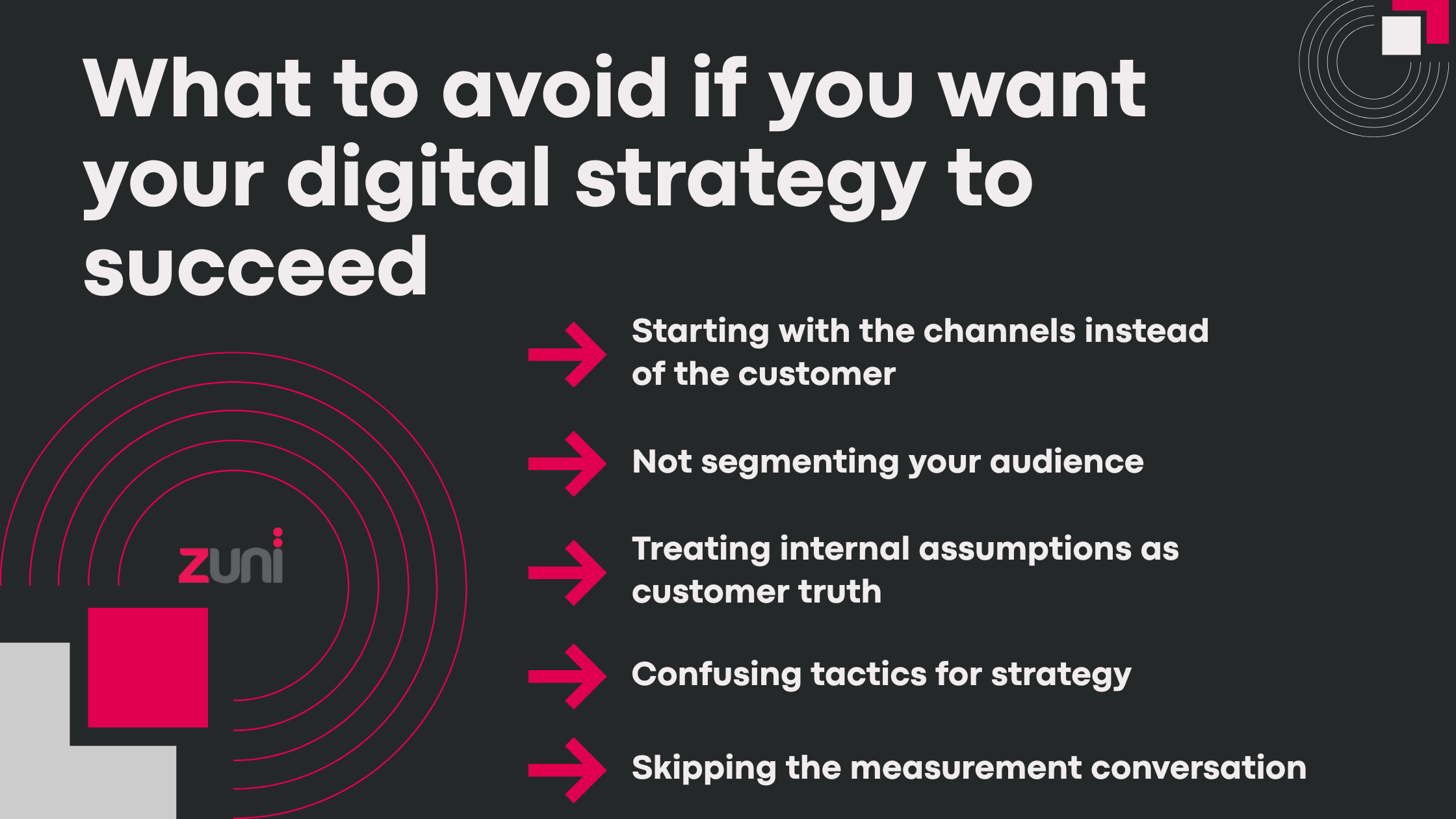
Avoid doing these things if you want your digital strategy to succeed.
Starting with the channels instead of the customer
A common starting point for a digital strategy is the channel list. What are we doing on social? What's our SEO plan? How are we using email? Those are valid questions, but they're the wrong place to begin.
Channels are a means to an end. The end is reaching your customer at the right moment with something useful to them, in that moment. If you don't have a clear picture of who those customers are, what they need, what matters to them and how they make decisions, your channel strategy is just activity. One that probably annoys your customers, and isn't optimised or well-integrated. A sales tactic, rather than a marketing tool. If you don't have clarity on how all the channels work together, within the context of what your customers are interested in, then you have confusion and inefficiency.
Not segmenting your audience
Digital marketing gives us the opportunity to shape different messages to different groups of people, based on their similarities. One of the most common ways a digital strategy underdelivers is by treating all customers as essentially the same, deploying a single message, a single channel mix, a single set of assumptions about what people want and when they want it.
Most customer bases contain meaningfully different groups. They may have different needs, or be different stages in their relationship with your organisation. These differences mean that different content resonates, different moments matter, and different things would cause them to engage.
Segmentation doesn't have to be complicated. It starts with understanding who your distinct audience groups actually are, what differentiates them behaviourally and attitudinally, and what that means for how you communicate with each of them. That understanding then flows into everything: channel selection, content, timing, measurement.
Treating internal assumptions as customer truth
Many organisations have a working model of its customers. Sometimes that knowledge is accurate and valuable. Sometimes it is out of date. Often it's never been validated, and is built on assumption. We've yet to work on a project where a business didn't gain new and significant ah-ha moments from taking the time to understand their target customer base properly.
When strategy is built on unchecked assumptions, you can end up optimising for a customer experience that doesn't reflect how your customers actually behave in the real world. And it misses out on real opportunities to move the dial, connect better with customers and drive long term business outcomes.
Analyse the data. Do the research. You spend time and money here, and save way more in the long run.
Confusing a list of tactics for a strategy
A strategy that tells you what to do without telling you why, or how to prioritise, or what success looks like, isn't really a strategy. It's a to-do list. The distinction matters when things change, when budgets get cut, when a new channel emerges or an old one underperforms. A real strategy gives you a framework for making those decisions. A strategy is more than a plan, it's an eco-system wide set of choices that work together to drive outcomes for the business by meeting real customer needs and behaviours.
Skipping the measurement conversation
Metrics matter. The start point is understanding what success looks like – what are the business requirements, and how are they measured. Metrics reflect what the strategy is designed to achieve. Building metrics, and associated workflows into the system is how you can judge not just if your strategy is working, but where and when it needs tweaking. We always start by defining why a business wants a digital strategy, and what success looks like to them.
What good looks like – The Zuni Approach
An ideal digital strategy is not just built on what the business wants, but on what the customer needs. Insight and opportunity to win lie in the intersection of those two rich worlds.
The best digital strategies have customer journey maps at the heart of them. Not touch point maps, but experience maps that allow a business to understand not just when to say what to whom, and in what channel, but why.
It makes clear choices about where to focus and what to set aside. And it defines success in terms the whole business can get behind. More than that, a strong digital strategy is built from cross functional input, shared vision and workflows, responsibilities and success criteria that allow it to be implemented successful.
If you'd like to talk about what that kind of process looks like in practice, we'd be happy to have the conversation.
Want to talk about how this applies to your organisation?
Get in touch with Zuni →More insights
View all articles →