
Customer Journey Mapping
What is a customer journey map and why you need one
May 2026 · Sharlene Zeederberg
Customer journey mapping is one of those terms that gets used a lot and understood differently. At Zuni, we've created thousands of bespoke customer journey maps for different businesses, in different industries and for different reasons. A customer journey map is not just how a customer moves through decision making to purchase, nor is it ever just their touch points.
So, what is it?
What is a customer journey map?
A customer journey map is a structured, visual representation of the experience a customer has as they move through a process to solve a particular problem – to which you may be one of the solutions.
As the name implies, the customer journey map is about the customer, not about you. It is not a flowchart of your internal processes. It is not a funnel. It is not a list of marketing channels.
It is a representation of the customer's experience, told from the customer's point of view. It is about their triggers, decision making, needs, and behaviours. Because it is about them, you can overlay where you win and lose in meeting them on that pathway, and where you are better or worse than the competition.
A good journey map captures:
- The stages a customer moves through
- What they are thinking, feeling, and doing at each stage
- The touchpoints where they interact with potential solutions
- The pain points and barriers that slow them down or push them away
- The moments of opportunity where a brand can make a meaningful difference
But the key is that it is about their problem solving, not only about their interaction with you.
What is an assumptive journey map?
At Zuni, our journey mapping engagements start with developing an assumptive map. It's counter to the theory, but central to bringing internal knowledge to the fore, ensuring research builds on what is known, tests what is assumed, and frames the research approach.
An assumptive map is built from internal understanding. We work with cross functional knowledge holders to gather their perspective on who the audiences are, and what their journey looks like.
This process does more than surface internal knowledge. It brings people together, creates a shared understanding of the cross functional partners who work to achieve the company objectives and gives your team a voice. It starts the process of bringing a customer centric mindset into the business.
How does research enrich the map?
Once the assumptive map exists, it's important to validate it by talking to customers, allowing their input to validate, challenge, and enrich it. Qualitative research is king here, for depth of understanding and exploring the knowledge you might not know you don't know. Quantifying these findings matters to create statistical certainty, prioritise barriers and frustrations and see how they differ by different segments.
The result is a journey map that reflects both the commercial reality of the business and the lived reality of the customer.
Do you need one?
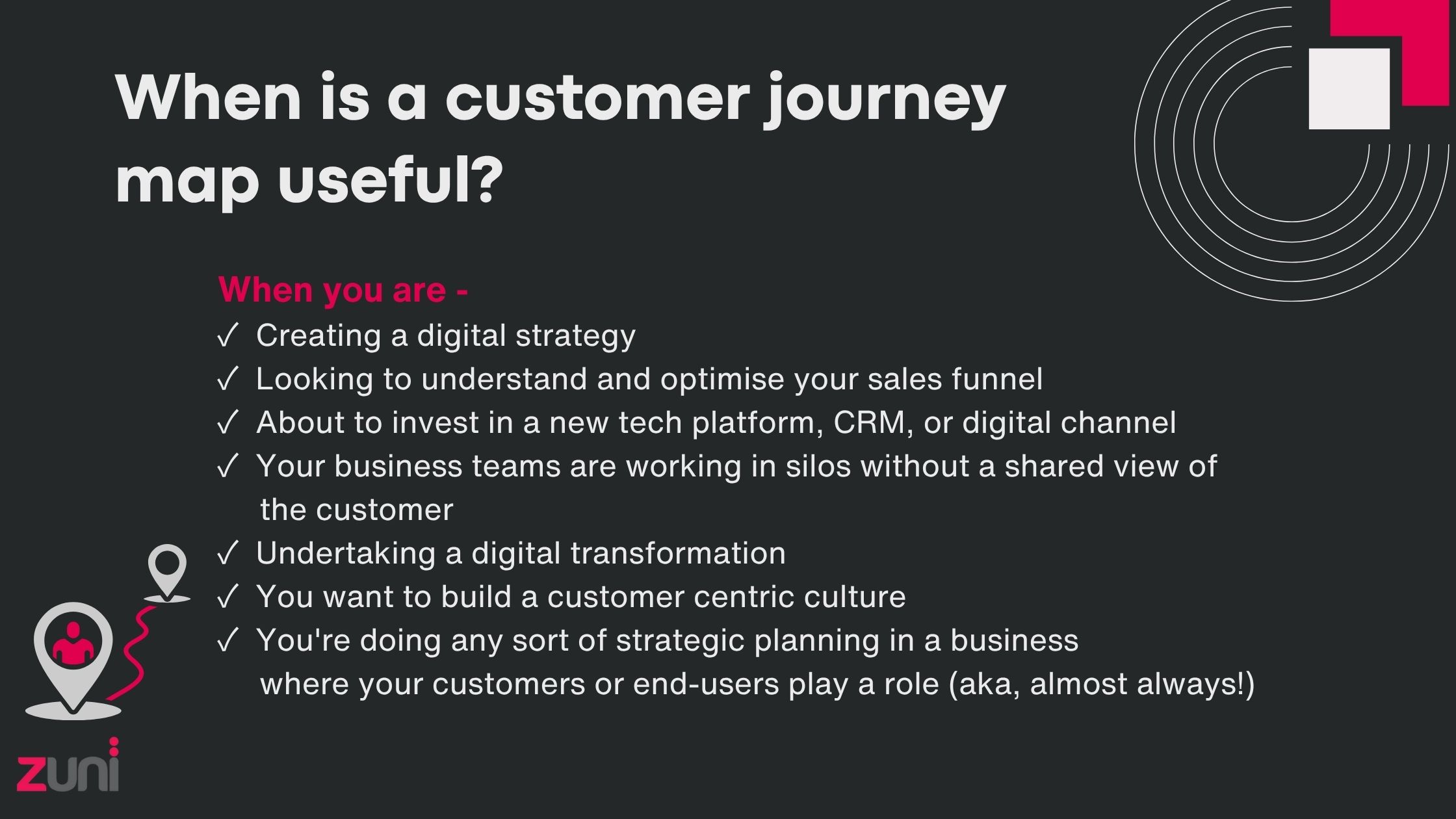
If you don't have one, you probably need one. They're central to a good digital strategy. But they are essential if you:
- Want to understand and optimise your sales funnel
- You're about to invest in a new platform, CRM, or digital channel
- Your marketing and digital teams are working in silos without a shared view of the customer
- You're planning a digital transformation and need to understand the current experience, touch points and barriers
- And, if you're doing any sort of strategic planning in a business where your customers or end-users play a role (aka, almost always!)
Thinking about customer journey mapping programmes? We deliver journey mapping programmes for corporates, government, and NFPs across Australia. Talk to us about what's involved.
Want to talk about how this applies to your organisation?
Get in touch with Zuni →More insights
View all articles →